Choose An Energy-Saving-Television
Avoid The Energy Guzzling TV Sets
Opt for the energy-saving-television like an LCD flat-panel-screen to have an effect on global warming. Avoid the hype about size and avoid the plasma energy guzzlers.
Was the importance of saving on energy on the minds of the early tv inventors? I'm sure it wasn't part of the equation in their time.
Wonder what they would think now of the advancements and the types of tv sets we have in our homes today?
Aren't we all just mesmerized by the appeal of technology?
Put together a theatre screen for a tv screen, a great movie on DVD, lots of snacks plus surround-sound, and you have the perfect ingredients for an evening of solid entertainment.
We quite enjoy being totally entertained in the comfort of our own homes. So, who wouldn't love to have the biggest and most spectacular television money can buy?
And though certainly some people are able to have exactly that, it's not realistic for most, when you first and foremost consider the cost. Secondly, how about the availability of
space to set up such a system?
The good news is most of us are reasonably satisfied with a much more scaled down version.
Now, if you are concerned about carbon emissions, the challenge
is to choose an energy-saving-television, and be happy about
your choice at the same time.
How Do You Know What TV To Pick?
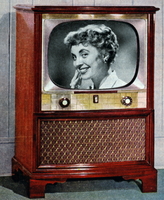
The Analog or "tube" tv was introduced in the 1930's and contains what is called cathode ray tubes. They send a beam through a tube which points to the screen. Images appear when the beam hits the screen.
A 28" analog tube tv runs on approximately 100 watts of power.
An LCD, or Liquid-Crystal-Display sends electrical currents through a thin layer of cells filled with a solution of liquid crystal. When the solution crystallizes, you see an image.
A 42" LCD flat-panel-screen will use twice the amount of power as the tube tv. A 40" LCD or less is a much more energy-saving- television than your tube tv.
A 50" rear projection tv is much more efficient than an LCD
or a plasma 50" tv, though the picture may not be as good.
The plasma tv has a bit more of a complicated technology.
A gassy substance called plasma forms millions of tiny bubbles which forms a layer. Every bubble is like a pixel made up of green, blue and red subcells.
An electrical current passes through the screen and makes the plasma give off ultraviolet rays. The phosphor coating on the plasma gives off the bright glowing color.
Plasma tv's are not known to be a type of an energy-saving-television, but are referred to more as tv energy guzzlers.
Depending upon what you are watching, the energy output can vary
alot.
Interesting to know, during peak tv programming times and with the coverage of special events, energy consumption skyrockets especially by high energy grabbing models.
These units will probably be banned in Europe because of the high energy cost. The state of California hopes to phase-out the sale of high energy televisions by the year 2013. This is partly due to the gigantic consumption rate during peak times, and also the high contribution to global warming.
A large plasma television (UK Study)could be responsible for emitting four times the amount of carbon dioxide into the air as 1 large "tube" tv.
Or, you can compare it to needing twice as much energy as your refrigerator-freezer.
Go For Energy Star Labels
Ask your salesman to show you the energy star rated models only.
Automatically there is a 30 percent increase in energy-saving-television efficiency over other models.
If all televisions in the United States met the requirements of Energy Star, energy savings could equal 1 billion dollars.
The reduction in greenhouse gases could equal approximately the output from one million vehicles.
Good At-Home Habits
Try to resist the urge to buy big. You save power, greenhouse gas emissions and money. The smaller the screen, the less energy it takes to run it.
Avoid more than one television in your home. (I know that one is difficult!)
Turn on the power-saver if your tv has the option. If it's an energy-saving-television, it should.
Turn down your room lights so that you don't need maximum tv brightness to see the screen.
Adjust the settings (or ask a technician how) for minimizing brightness and contrast.
When finished watching, turn it off. Make sure you have it on the power bar.
Limit tv time altogether in your home. It really isn't a bad idea in general to find other things to do, instead of sitting for hours on a daily basis.
Leave Energy-Saving-Television, Return To Cut Hydro Costs
Return To Carbon Footprint Defined Home Page



Thanks For Your Support
Green Maven!

Popular Tips
Recycling Tips
Garage Sale Tips
Laundry Room
Green Travel
The Company Money
Eco-Baby Gift
Make A Diaper Cake